

Futoshiki
Puzzle · Free online game · No download
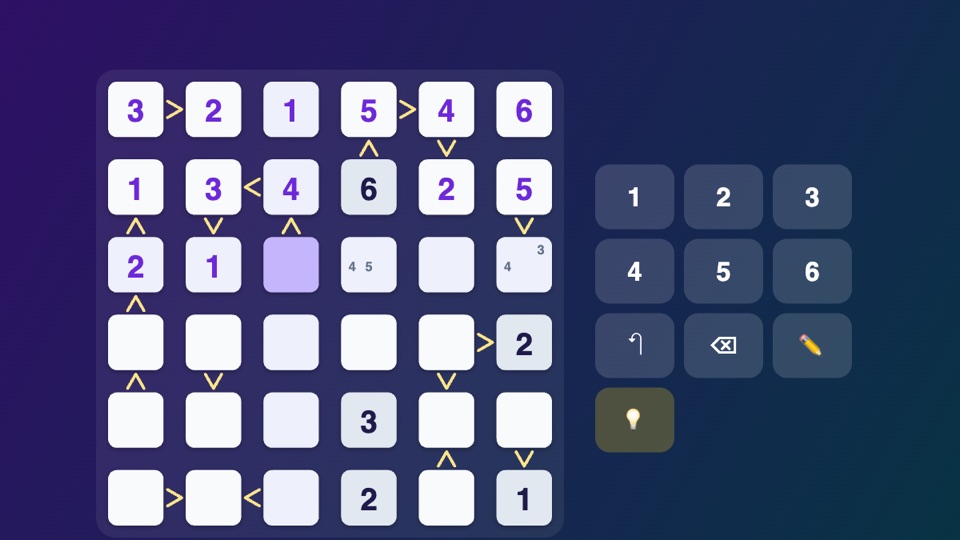
About Futoshiki
Futoshiki is a Japanese number puzzle whose name means “not equal”. Like Sudoku, every row and every column must contain each number exactly once. The twist is the small < and > signs between some squares: the number on the open side of a sign must be bigger than the number at its point. A few numbers are given to get you started, and the signs do the rest.
How to play Futoshiki
- Tap a square, then tap a number on the keypad to write it in. Tap the same number again to clear it.
- Every row and every column uses each number from 1 to the size of the grid exactly once.
- The point of each sign faces the smaller number. Signs work across (< >) and up and down (∧ ∨).
- Turn on Notes (✏️) to pencil small candidates into a square. When you place a number, matching notes in the same row and column disappear on their own.
- Repeated numbers turn red, and a sign turns red when the two numbers next to it break it.
Three sizes, one answer each
Easy is a 5×5 grid, Medium is 6×6 and Hard is 7×7 with fewer clues. Every puzzle is made fresh and checked by a solver, so there is always exactly one correct answer. Your time is your score, and your best time is saved for each size. Stuck? Hint fills in one correct square for a 20-second penalty, and Undo takes back your last move. On a computer you can type numbers, move with the arrow keys, press N for notes and Ctrl+Z to undo.
Futoshiki tips
Look for chains of signs first. A square that is smaller than its neighbour can never be the largest number, and a square at the bottom of a chain of three signs can be at most the grid size minus three. In a 5×5 grid, a square with two “smaller than” signs pointing away from it can only be 3, 4 or 5. Pencil these limits in with Notes, then use the row and column rule exactly as in Sudoku. When only one square in a row can take a number, it must go there.
More number puzzles: Calcudoku, Sudoku and Bridges.
Futoshiki FAQ
What does Futoshiki mean?
It is Japanese for “not equal” or “inequality” — the puzzle is built around greater-than and less-than signs.
Which way do the signs point?
The point of the sign always faces the smaller number, just like in maths: 2 < 5 and 5 > 2.
Does every puzzle have one solution?
Yes. Each puzzle is checked by a solver before you see it, so there is exactly one correct answer and no guessing is needed.
How are Futoshiki and Sudoku different?
Both use the “once per row and column” rule, but Futoshiki has no 3×3 boxes. Instead, the inequality signs between squares give you the clues.
Is Futoshiki free?
Yes. It is free to play in your browser on phones, tablets and computers, with no download or sign-up.


